NB-IoT electrochemical gas detector: Professional NB-IoT Smart Gas Detection Solutions by Wanlin Fir
I. Why 4G Gas Detectors Represent the Critical Future of Gas Safety Worldwide
Gas leaks represent one of the most dangerous and potentially catastrophic domestic and industrial safety hazards worldwide. Unlike fire - which typically produces visible smoke and detectable heat before reaching life-threatening intensity - gas leaks are frequently invisible, odorless (natural gas odorization with mercaptan is not universal or guaranteed, and odor fade can occur in certain pipeline conditions), and capable of reaching explosive concentrations without any warning to building occupants. According to global safety data, gas-related incidents (explosions, asphyxiation, carbon monoxide poisoning) cause thousands of fatalities and billions of dollars in property damage annually across residential, commercial, and industrial sectors. The challenge is compounded by the fact that gas leaks can occur when buildings are unoccupied or when occupants are sleeping - precisely when human detection is impossible. Traditional standalone gas detectors - even when correctly installed and maintained - share the same critical limitation as conventional smoke detectors: they can only alert people within audible range. If a gas leak develops when the building is empty, when occupants are asleep in distant rooms, or when elderly or hearing-impaired individuals cannot perceive the alarm, a traditional audible-only gas detector provides essentially zero protection against catastrophic outcomes. This fundamental limitation is precisely why connected gas detectors - and specifically 4G standalone cellular gas detectors with integrated automatic solenoid valve shut-off control - represent the future of comprehensive gas safety protection.
A 4G gas detector utilizes the same ubiquitous cellular network infrastructure that powers mobile phones worldwide (4G LTE networks operated by carriers in virtually every country) to transmit instant alert notifications to designated smartphones, central monitoring stations, building management platforms, and emergency contacts the moment combustible or toxic gas concentrations exceed safety thresholds. Unlike WiFi-dependent smart detectors that fail when internet service is interrupted, routers malfunction, or WiFi passwords change, a 4G gas detector operates on its own independent cellular connection - requiring only a SIM card with active data plan and cellular network coverage. This genuine plug-and-play connectivity model is transformative: for residential homeowners (instant phone alerts whether at home, at work, or on vacation - plus automatic gas valve shut-off preventing continued gas flow), for rental property landlords and property managers (professional gas monitoring without depending on tenant cooperation or WiFi access), for commercial kitchens and restaurants (centralized monitoring of multiple gas appliances with automatic emergency shut-off), for industrial facilities (remote monitoring of gas storage areas, boiler rooms, and processing equipment), and for LPG distributors and gas utilities (remote monitoring of customer installations with automatic safety shut-off reducing liability). The integration of 4G connectivity with automatic solenoid valve control is the critical differentiator: when the detector senses gas above threshold, it not only sounds an audible alarm and sends remote notifications - it simultaneously closes the gas supply via the connected solenoid valve, preventing continued gas flow and stopping the leak at its source.
The global market for connected gas detection is experiencing sustained growth driven by structural trends: (1) strengthening regulatory mandates worldwide requiring gas detectors in residential, commercial, and industrial settings, (2) insurance industry adoption of connected gas detection for risk reduction and premium incentives, (3) LPG and natural gas utility programs promoting connected detection for customer safety and liability management, (4) growing awareness of gas safety following high-profile gas explosion incidents globally, and (5) urbanization with increasing density of gas infrastructure in residential and commercial buildings. Wanlin Fire Control is a direct manufacturer of professional-grade 4G gas detectors with integrated solenoid valve control, offering internationally certified products at genuine factory-direct pricing to distributors, importers, wholesalers, gas utilities, property developers, and government procurement agencies worldwide.
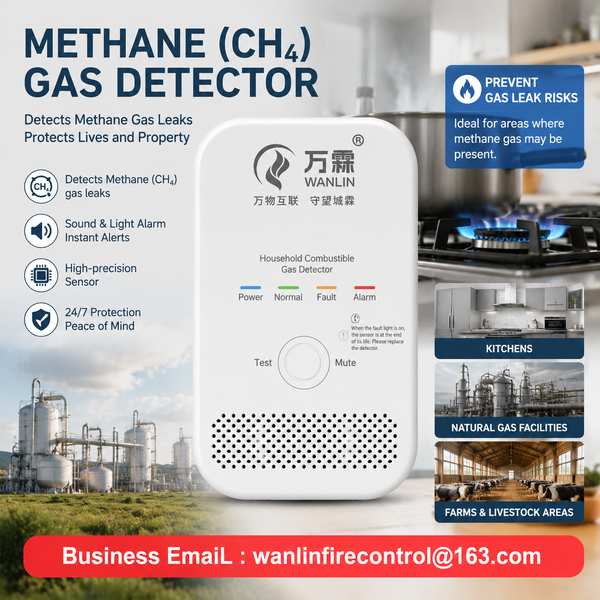
II. Complete Technical Specifications of NB-IoT electrochemical gas detector - Professional 4G Gas Detector
The NB-IoT electrochemical gas detector is a professional-grade 4G gas detector engineered and manufactured by Wanlin Fire Control at our ISO9001:2015 certified production facility in China. The device integrates advanced catalytic combustion, NDIR infrared, or electrochemical gas sensing technology for reliable and false-alarm-resistant gas detection with 4G Cat.1 cellular connectivity enabling instant remote alerting to smartphones, cloud platforms, and monitoring centers. A critical integrated feature is the automatic solenoid valve control output - when gas concentration exceeds the alarm threshold (typically 7% LEL for combustible gases per EN50194), the detector simultaneously sounds an 85dB+ audible alarm, sends instant remote notifications via 4G, and activates the connected solenoid shut-off valve to stop gas flow at the source. Designed and certified for residential, commercial, and light industrial applications, the device meets or exceeds the requirements of multiple international gas safety standards including EN50194 (European Standard for Electrical Apparatus for Detection of Combustible Gases in Domestic Premises), GB15322 (China National Standard for Combustible Gas Detectors), and CCCF mandatory product certification.
- Multi-Gas Detection Capability: The device is equipped with a high-precision semiconductor/catalytic combustion/infrared gas sensor capable of detecting multiple combustible gas types including natural gas (methane CH4), liquefied petroleum gas (LPG - propane/butane mixture), coal gas, and biogas. Detection range: 0-20% LEL (Lower Explosive Limit) with response time < 30 seconds. Alarm threshold configurable at 5%, 10%, or 15% LEL per customer requirements and local regulations, ensuring early warning well before gas concentration reaches dangerous explosive levels.
- Automatic Solenoid Valve / Shut-Off Valve Control: The device features an integrated relay output for direct connection to a normally-closed solenoid shut-off valve installed on the gas supply line. Upon detecting gas concentration exceeding the alarm threshold, the detector activates the relay output within 3 seconds, automatically closing the solenoid valve to cut off the gas supply at the source. This integrated detection-and-shut-off functionality provides comprehensive protection - the detector not only alerts occupants to the gas leak but simultaneously eliminates the hazard by stopping the gas flow, preventing escalation from leak to explosion or fire. Valve status feedback monitoring ensures the system verifies successful shut-off.
- 4G Cat.1 Cellular Connectivity with Remote Alerting: Integrated 4G Cat.1 (LTE Category 1) cellular communication module provides reliable wireless connectivity optimized for IoT devices. Upon gas detection or fault event, the device instantly transmits alert notifications via: push notification to smartphone app (iOS/Android), SMS text message to designated emergency contacts, automated phone call with text-to-speech alert, email notification with event details, and API webhook to central monitoring stations. No WiFi network, hub, or gateway required - the device operates independently on cellular networks. Supported frequency bands: LTE-FDD B1/B3/B5/B7/B8/B20, LTE-TDD B38/B40/B41 for global compatibility.
- High-Output Acoustic and Visual Alarm: Built-in 95dB+ piezoelectric siren (measured at 3 meters) provides loud, unmistakable alarm notification for building occupants. High-intensity red LED strobe light provides visual alerting for hearing-impaired occupants and noisy environments. Distinctive alarm patterns: continuous siren for gas alarm, intermittent chirp for low battery, different pattern for sensor fault - enabling users to identify the alert type by sound pattern alone. User-selectable silence/hush function for addressing non-emergency triggers (e.g., cooking vapors).
- Industrial-Grade Sensor with Long Service Life: The gas sensor element is sourced from Tier-1 Japanese or European sensor manufacturers (Figaro, Nemoto, SGX Sensortech, or equivalent) with proven field reliability of 5+ years under normal operating conditions. Catalytic combustion sensor for broad-spectrum combustible gas detection with excellent linearity and repeatability. Semiconductor sensor for high sensitivity to low gas concentrations. Infrared (NDIR) sensor option available for environments requiring immunity to sensor poisoning (silicones, halogens, sulfur compounds). Sensor end-of-life detection - device automatically alerts when sensor calibration drift exceeds acceptable limits, prompting replacement.
- Comprehensive Self-Diagnostic and Fault Monitoring: The device continuously monitors its own operational status and reports the following conditions via local indicators and cloud platform: sensor fault or calibration drift, 4G network connection failure, cloud platform registration failure, low battery voltage warning, tamper/detachment alarm (anti-tamper switch triggers if device removed from mounting bracket), solenoid valve connection failure (open circuit detection), and end-of-life notification (after 5+ years service). Automatic monthly self-test cycle verifies sensor response, alarm sounder, LED indicator, communication module, and valve relay function - with results uploaded to cloud platform.
- Multiple Power Supply Options for Flexible Installation: Standard configuration: DC12V external power supply (AC adapter included, 100-240V AC input, 50/60Hz global compatibility) with built-in rechargeable lithium battery backup (maintains operation for 8+ hours during power outage). Alternative configurations: DC24V industrial power supply for control panel integration, PoE (Power over Ethernet) for smart building installations, or fully battery-operated variant using high-capacity lithium battery pack (3-year design life, suitable for locations without accessible power outlets). Power supply status monitored and reported to cloud platform with low battery alerts.
- EN50194 / UL2075 Compliance with International Certifications: Fully compliant with EN50194-1 (Electrical apparatus for the detection of combustible gases in domestic premises - test methods and performance requirements), UL2075 (Gas and Vapor Detectors and Sensors), and GB15322 (China national standard for combustible gas detectors). Holds CCCF mandatory product certification. Additional certifications available per market requirements: CE marking (EMC + LVD), RoHS 2.0, FCC Part 15 (4G radio module), CE-RED (Radio Equipment Directive), ATEX Directive 2014/34/EU (explosion-proof models), and IECEx (international explosion-proof certification). All certification documents provided in English for distributor and end-customer verification.
- Flame-Retardant and Chemical-Resistant Housing Construction: Device enclosure and mounting base constructed from flame-retardant ABS or polycarbonate material certified to UL94 V-0 flame rating - the highest classification for self-extinguishing plastic materials. The housing resists ignition and does not contribute to flame propagation, providing an additional layer of safety when installed in proximity to potential gas leak sources. Chemical-resistant formulation protects against degradation from common household chemicals, cleaning agents, and cooking oils that may be present in kitchen and utility room environments.
- Flexible Installation and Mounting Options: Designed for wall mounting at the appropriate height for the target gas type: natural gas/methane (lighter than air) - mount 30cm below ceiling, LPG/propane (heavier than air) - mount 30cm above floor. Screw-fixed mounting bracket included for permanent installation. 3M industrial-grade adhesive option for surfaces where drilling is not permitted. Installation height guide and positioning recommendations provided in English installation manual. Optimal placement: within 1.5m of potential gas leak sources (gas stove, boiler, water heater, gas meter), avoiding direct exhaust from cooking appliances, and outside areas with high humidity or condensation.
- Wide Operating Environment Range: Operating temperature: -10 to +55 degrees C for standard models, -20 to +60 degrees C for industrial/explosion-proof variants. Operating humidity: up to 95% RH non-condensing. IP42 ingress protection rating for standard indoor models (protected against solid objects >1mm and vertically falling water drops). IP65/IP66/IP67 rated variants available for outdoor, washdown, and harsh environment applications. ATEX Zone 1 / Zone 2 and IECEx certified variants for hazardous area installations in oil and gas, chemical processing, and mining environments.
- Independent Type Test Report from National Authority: Fully tested and found compliant with all GB15322 requirements by the National Fire Electronic Product Quality Supervision and Inspection Center. Formal type test report provides independent third-party validation of gas detection performance, alarm threshold accuracy, response time, environmental durability, electromagnetic compatibility, and long-term stability. Test reports available in English for distributor regulatory submissions.
- 3C Compulsory Product Certification (CCCF): Holds the CCCF mandatory product certification issued by the Fire Product Conformity Assessment Center of the Ministry of Emergency Management of China, evaluated under the national standard GB15322 for combustible gas detectors. This certification confirms the product meets all mandatory safety, performance, reliability, and manufacturing consistency requirements for gas detection and alarm products in the Chinese market and provides a robust foundation for international certification equivalence evaluation.
- CMA/CNAS Accredited Third-Party Laboratory Testing: The product has been independently tested and verified by third-party testing laboratories bearing CMA (China Metrology Accreditation) and CNAS (China National Accreditation Service for Conformity Assessment) accreditation marks. These internationally recognized accreditations under ILAC-MRA (International Laboratory Accreditation Cooperation Mutual Recognition Arrangement) provide independent, objective validation of product quality claims, performance specifications, and compliance with applicable international standards - accepted by regulatory authorities in over 100 countries.
The NB-IoT electrochemical gas detector is a professional-grade 4G combustible gas detector designed and manufactured by Wanlin Fire Control. It integrates advanced gas sensing technology with 4G Cat.1 cellular connectivity, automatic solenoid valve control, and robust physical design for reliable gas leak detection in residential, commercial, and industrial applications. Below are the complete technical specifications:
III. Wanlin Fire Control - Your Direct 4G Gas Detector Manufacturer in China
Wanlin Fire Control, headquartered in Shaanxi Province, China, is a specialized and dedicated manufacturer of professional gas detection and fire safety equipment with over 15 years of continuous production experience. Our modern 20,000+ square meter manufacturing facility operates under ISO9001:2015 certified quality management systems, staffed by a skilled workforce of 200+ employees including 15+ dedicated research and development engineers focused exclusively on gas detection and fire safety product innovation. We are a genuine manufacturer - not a trading company, not a reseller, not an intermediary. Wanlin directly controls and executes every critical stage of the production process: gas sensor selection and procurement from Tier-1 Japanese and European sensor manufacturers (Figaro, Nemoto, SGX Sensortech), electronic circuit design and PCB layout optimized for gas detection signal processing, surface-mount technology (SMT) PCB assembly on automated production lines, precision injection molding of detector housings in flame-retardant ABS, gas sensor calibration using NIST-traceable certified reference gas standards in our in-house calibration laboratory, final product assembly with 100% calibration verification and functional testing of every single unit before shipment, and export-grade packaging designed for international logistics.
Key Reasons to Source NB-IoT electrochemical gas detector from Wanlin Fire Control:
- True Direct Manufacturer: You communicate and transact directly with the factory that designs, calibrates, and produces your gas detectors - no trading company intermediaries adding cost, transparent and direct access to our engineering, production, and quality teams.
- Genuine Verifiable International Certifications: EN50194 (EU harmonized standard for combustible gas detectors) with test reports from EU-accredited Notified Bodies, GB15322 with CCCF mandatory product certification (China national standard), CE marking, RoHS 2.0, FCC Part 15, CE-RED - all certification numbers verifiable on official databases.
- ISO9001:2015 Certified Quality Management: Systematic quality control at every production stage: incoming sensor and component inspection, in-process QC checkpoints at critical manufacturing steps, 100% calibration verification using certified reference gas standards, 100% functional testing of every unit including sensor response, alarm output, solenoid valve control, and 4G communication.
- Tier-1 Japanese/European Gas Sensors: We integrate industry-leading sensor elements from Figaro (Japan), Nemoto (Japan), and SGX Sensortech (UK/Switzerland) - the same sensor manufacturers supplying Honeywell Analytics, MSA, and Drager. Sensor quality directly determines detector accuracy, stability, and service life.
- Integrated Solenoid Valve Control: Critical safety feature: automatic gas shut-off when leak detected. Our detectors include relay output for direct solenoid valve connection - no additional controller required. This provides complete protection: detect the leak AND stop the gas flow at source.
- Comprehensive OEM/ODM Manufacturing Services: Custom laser-engraved or silk-screened branding on device housings, fully customized retail packaging, branded user manuals in your language, white-label mobile application with your branding, co-certification listing your brand on international certifications.
- Competitive Factory-Direct Pricing: 30-50% below equivalent specification products from Honeywell Analytics, MSA, Drager, Kidde, and X-Sense - achieved through vertical integration and the direct-manufacturer business model, not through quality compromise.
- Reliable Production Capacity: 100,000+ unit monthly capacity, consistent quality across batches, proven on-time delivery track record with international logistics partners, diversified sensor sourcing strategy mitigating supply chain risks.
- 15+ Years International Export Experience: Products shipped to 50+ countries across six continents. Deep understanding of international logistics, export documentation (Certificate of Origin, Form A/E/F), and destination-country customs clearance.
- Flexible MOQ: Standard product MOQ: 100 units. OEM/private label MOQ: 500 units. Sample evaluation orders: 5-20 units. We support modest initial orders for market testing and scale production as your business grows.
- Dedicated English-Language Distributor Support: English-speaking account management, direct engineering technical support, comprehensive #rega:433#ing material package, product training, and responsive after-sales warranty service.
IV. Competitive Advantages of Wanlin NB-IoT electrochemical gas detector - The Smarter Alternative to Honeywell, MSA and Drager
For gas safety equipment distributors, importers, wholesalers, gas utilities, and project buyers, selecting a gas detector manufacturing partner is one of the most consequential strategic business decisions. The manufacturing partner you choose determines: your product quality and detection accuracy, your cost structure and margin profile, your brand-building potential (OEM/private label), your regulatory compliance in target markets, your supply chain reliability, and your long-term business scalability. When comparing across all dimensions - sensor quality, calibration accuracy, certification authenticity, pricing, OEM flexibility, solenoid valve integration, and partnership approach - Wanlin Fire Control demonstrates clear and compelling competitive advantages over both premium international brands (Honeywell Analytics, MSA, Drager, Kidde, X-Sense) and lower-tier Alibaba manufacturers.
Value Comparison vs. Honeywell Analytics, MSA, Drager, Kidde and X-Sense: The NB-IoT electrochemical gas detector from Wanlin delivers professional-grade gas detection performance at 30-50% below the cost of equivalent products from premium international brands. The price advantage stems from Wanlin's direct-manufacturer business model - we design, manufacture, calibrate, and test every gas detector in our ISO9001:2015 certified factory in China. Honeywell Analytics, MSA, Drager, Kidde, and X-Sense are excellent products with decades of brand recognition, but their pricing reflects substantial investments in brand marketing, multi-tier distribution (manufacturer to regional distributor to national distributor to wholesaler to retailer - each layer adding 20-40% markup), and corporate overhead. Wanlin offers equivalent core technology - catalytic combustion, NDIR infrared, or electrochemical sensing with identical-grade Japanese/European sensor elements (Figaro, Nemoto, SGX Sensortech, etc.), identical-grade 4G Cat.1 communication modules (Qualcomm/Quectel chipsets), same international certifications (EN50194, GB15322 CCCF, CE, RoHS, FCC), and integrated solenoid valve control capability - at factory-direct pricing with no intermediary markups. For distributors and importers: the pricing advantage means healthy 40-60% margins (vs. 20-30% typical for premium brands), competitive retail pricing that wins market share in price-sensitive markets, and the unique opportunity to build your own gas safety brand equity through Wanlin's comprehensive OEM program.
Additional Differentiating Competitive Advantages of Wanlin NB-IoT electrochemical gas detector:
- Sensor Technology Parity with Premium Brands: Wanlin integrates the same Tier-1 sensor elements (Figaro TGS series catalytic sensors, Nemoto NAP-series catalytic bead sensors, SGX Sensortech NDIR infrared sensors) used by Honeywell Analytics, MSA, and Drager. The sensor is the heart of any gas detector - and Wanlin uses the same hearts as the premium brands. Price difference derives from business model efficiency, not sensor quality compromise.
- NIST-Traceable Calibration: Every Wanlin gas detector is calibrated using certified reference gas standards traceable to NIST/ISO 17025 accredited calibration laboratories. Calibration is performed in our dedicated in-house calibration lab, with calibration certificates available upon request for project and tender submissions.
- Automatic Solenoid Valve Control - Complete Safety Solution: Unlike many premium-brand gas detectors that only provide audible/visual alarms (requiring separate and costly shut-off controllers), Wanlin gas detectors include integrated relay output for direct solenoid valve connection. One device = detection + alarm + automatic gas shut-off. This single-feature integration delivers significant cost savings and installation simplicity for residential and commercial applications.
- Complete 4G Safety Product Ecosystem: Single supplier for comprehensive gas and fire safety: combustible gas detectors (natural gas, LPG, methane, propane, butane), carbon monoxide detectors, combination gas+CO detectors, smoke detectors, heat detectors, manual call points, sounder strobes - all interoperating on the same cloud platform with single support contact and warranty process.
- Cloud Platform Included - No License Fee: Wanlin cloud monitoring platform (web portal + iOS/Android apps) included with every detector at no recurring license fee. Real-time multi-device dashboard, alarm event management, automated compliance reporting, hierarchical building management, and REST API for third-party integration - all at zero additional cost.
- Certifications That Are Genuine and Verifiable: Every Wanlin certification can be independently verified on the respective official database. We encourage verification - counterfeit certifications from lower-tier suppliers will fail regulatory inspection, potentially resulting in product seizure, fines, legal liability, and reputation damage.
- Innovation Speed and Gas-Specific R&D: Our 15+ dedicated R&D engineers focus exclusively on gas and fire detection. New sensor integrations, multi-gas capabilities, and feature improvements developed with typical 3-6 month cycles - substantially faster than the multi-year corporate product development cycles of large multinationals.
- Environmental and Ethical Manufacturing: ISO14001 certified environmental management, RoHS 2.0 and REACH compliant, WEEE directive support, FSC-certified recyclable packaging, conflict minerals policy with CMRT declarations, and ethical labor practices.
V. Frequently Asked Questions About NB-IoT electrochemical gas detector
Q1: What gas sensing technology does the Wanlin 4G gas detector use, and what gas types can it detect?
The Wanlin 4G gas detector utilizes multiple sensor technology options configurable per customer requirements: (A) Catalytic combustion (pellistor) sensor - the most established technology for combustible gas detection. Principle: a catalytic bead heated to approximately 500C; when combustible gas contacts the bead surface, catalytic oxidation occurs, raising bead temperature and changing its electrical resistance proportionally to gas concentration. Advantages: broad-spectrum detection of virtually all combustible gases (methane, propane, butane, hydrogen, etc.), excellent linearity across 0-100% LEL range, proven reliability with decades of field deployment, relatively low cost. (B) Semiconductor (metal oxide) sensor - Principle: a metal oxide semiconductor (typically tin dioxide SnO2) changes electrical conductivity when gas molecules adsorb onto its surface. Advantages: very high sensitivity at low gas concentrations (ppm-level detection), fast response time, long sensor life (5-10 years), low power consumption. Ideal for: residential kitchen gas leak detection, early warning applications. (C) Non-dispersive infrared (NDIR) sensor - Principle: gas molecules absorb infrared light at specific wavelengths; the sensor measures IR absorption to determine gas concentration. Advantages: immune to sensor poisoning (silicones, halogens, sulfur compounds), no oxygen required for operation (works in inert atmospheres), failsafe operation, very long service life (10+ years). Ideal for: industrial environments, wastewater treatment, biogas, environments with sensor poisons. Detected gas types: Natural gas (methane CH4), LPG (propane C3H8 + butane C4H10), coal gas/town gas, biogas, hydrogen (H2), ammonia (NH3). Custom gas calibration available for specific applications.
Q2: How does the automatic solenoid valve shut-off system work with the 4G gas detector?
The Wanlin 4G gas detector features integrated solenoid valve control for automatic gas supply shut-off upon leak detection: (A) System components - the gas detector provides a relay output (dry contact, NO/NC configurable, rated for 3A at 250V AC or 5A at 30V DC). The solenoid valve is a normally-closed (NC) type installed on the main gas supply pipe. When the detector is powered and no gas leak is detected, the relay energizes the solenoid valve coil, opening the valve for normal gas flow. Upon detecting gas concentration exceeding the alarm threshold, the detector de-energizes the relay within 3 seconds, the solenoid valve spring-returns to the closed position, and gas flow is immediately cut off at the source. (B) Safety design - fail-safe operation: if power to the detector is lost (power outage, disconnected), the relay de-energizes and the valve automatically closes - gas flow cannot resume without intentional restart. Manual reset required after shut-off: the valve remains closed even after gas concentration returns to safe levels, requiring a deliberate manual reset to restore gas flow - preventing automatic gas restoration into an unoccupied space. (C) Solenoid valve compatibility - supports standard 1/2 inch, 3/4 inch, 1 inch, and larger pipe diameters. Compatible with valves from major manufacturers. Wanlin can supply compatible valves tested and certified with our detectors, or your customer can use locally sourced valves meeting the relay specifications. (D) Valve connection monitoring - the detector continuously monitors the solenoid valve circuit for open circuit, short circuit, or coil failure and reports any valve fault via cloud platform and local LED indicator. (E) Remote valve control - through the Wanlin cloud platform and mobile app, authorized users can manually close the gas valve remotely for vacation mode, suspected leak investigation, or emergency shutdown.
Q3: How is the 4G gas detector installed, and what are the recommended mounting heights for different gas types?
Critical installation guidance - mounting height depends on target gas density relative to air: (A) Natural gas / Methane (CH4) - lighter than air (density approx 0.55 relative to air). Gas rises and accumulates near ceiling. Mount detector: 30cm (12 inches) below ceiling, within 1.5m horizontal distance from potential leak source (gas stove, boiler, water heater). (B) LPG / Propane / Butane - heavier than air (density approx 1.5-2.0 relative to air). Gas sinks and accumulates near floor. Mount detector: 30cm (12 inches) above floor, within 1.5m horizontal distance from potential leak source (LPG cylinder, gas stove using bottled gas). Ensure unobstructed path between floor and detector. (C) General installation guidelines: do NOT install within 1.5m of air conditioning vents, fans, open windows, or doors (air currents disperse gas causing delayed/missed detection), do NOT install in enclosed dead-air spaces (behind furniture, inside cabinets, corners), do NOT install above cooking appliances where normal cooking vapors/steam/heat will cause false alarms, do NOT install in bathrooms or high humidity areas, do NOT paint the detector housing (blocks gas entry and voids warranty). Installation procedure: 2 screws (included) for wall mounting bracket, or 3M adhesive pad. Connect power adapter (DC12V) or battery pack. For solenoid valve integration: connect valve wires to relay output terminals per wiring diagram. Power on - LED indicates warm-up period (60-90 seconds for sensor stabilization). Test with calibrated gas or butane lighter (unlit, brief gas release near sensor) to verify detection and alarm function.
Q4: What maintenance does the 4G gas detector require, and how often should it be tested?
Maintenance requirements: (A) Weekly visual check - verify power LED is on (solid green), no fault indicators (flashing yellow/red), device securely mounted, no physical damage or obstruction blocking gas entry vents. (B) Monthly functional test - press and hold test button for 3 seconds. Device should: sound alarm (continuous siren), flash strobe light, trigger cloud notification to app/phone, and if solenoid valve connected, verify valve closes. Check cloud platform for test event logged. (C) Quarterly detailed test - test with a small amount of calibration gas or unlit butane lighter (brief controlled gas release near sensor - approximately 1 second). Verify alarm activates within 5-30 seconds. Verify cloud notification received. Verify solenoid valve closure if connected. This test verifies the gas sensor is actively detecting, not just the electronics. (D) Annual professional inspection - verify calibration accuracy with calibrated gas source (2% methane in air or appropriate test gas), check all mounting hardware, inspect solenoid valve for corrosion or mechanical wear, verify all wiring connections, replace sensor if approaching end of design life (5 years for catalytic/semiconductor, 10 years for NDIR). (E) Sensor replacement - the detector signals end-of-life via cloud notification and yellow LED. Sensor replacement by qualified technician: order replacement sensor module from Wanlin, power off detector, remove old sensor, insert new sensor, power on, allow warm-up, verify with test gas. (F) Cleaning - gently vacuum exterior vents every 3-6 months to remove dust. Do NOT use water, solvents, or compressed air (damages sensor). Do NOT use cleaning chemicals near the detector (sensor may react to solvent vapors causing false alarm or sensor damage).
Q5: Does the 4G gas detector work with different types of natural gas and LPG used in different countries?
Yes, designed and calibrated for global gas type compatibility: (A) Natural gas (methane-based) variations - US/Canada: approx 95% methane, 3% ethane, 2% other. UK/Europe: approx 92% methane, 5% ethane, 3% nitrogen. Russia/CIS: 92-98% methane. Middle East: 90-95% methane. Southeast Asia: 85-95% methane. Australia: 90-95% methane. The catalytic combustion sensor responds to all combustible hydrocarbons, and detection response to methane-dominant natural gas is consistent across compositional variations. The key parameter is the Lower Explosive Limit (LEL) - natural gas LEL is approximately 5% by volume in air regardless of exact composition. (B) LPG variations - commercial propane (>95% C3H8), commercial butane (>95% C4H10), LPG mixture (60% propane + 40% butane typical), auto LPG (varies by country and season). The catalytic sensor responds to all these hydrocarbons with similar sensitivity. The alarm threshold (typically 10% LEL) provides consistent protection. (C) Calibration - factory-calibrated with methane (CH4) as reference gas for natural gas models, and propane (C3H8) for LPG models. Cross-sensitivity characterization data provided in technical datasheet. (D) Custom calibration - for specific gas mixtures (biogas with 60% CH4 + 40% CO2, hydrogen-natural gas blends, refinery gas streams), Wanlin offers custom factory calibration using your specified gas composition. Minimum order quantity applies. (E) Multi-gas models - detectors configured for both natural gas (ceiling mount sensor) and LPG (floor mount sensor) in a single unit available for markets where both gas types are commonly used.
Q6: How does the 4G gas detector minimize false alarms from cooking vapors, cleaning products, and other non-gas sources?
False alarm reduction strategies: (A) Sensor selectivity - catalytic combustion sensors are highly selective to combustible gases vs. non-combustible vapors. Water vapor (steam), carbon dioxide (CO2), nitrogen (N2), and oxygen (O2) do not trigger the catalytic sensor. The sensor only responds to oxidizable (combustible) gases. (B) Alarm threshold - the standard alarm point of 10% LEL (approximately 0.5% methane or 0.2% propane by volume in air) is deliberately set well above trace vapor levels from normal cooking. Brief cooking events (gas stove ignition momentary gas puff from unlit burner) produce localized concentrations typically well below 10% LEL. (C) Time-delay algorithm (configurable) - detector can be configured with brief confirmation delay (5-10 seconds) requiring sustained gas concentration above alarm threshold before activating alarm. This filters out transient gas spikes (brief puff during stove ignition, passing vehicle exhaust near open window). (D) Semiconductor sensors - note broader cross-sensitivity to alcohol vapors (cooking wine, vanilla extract, cleaning alcohol, perfume), ammonia (cleaning products), and hydrogen (charging lead-acid batteries). Mitigation: install at recommended distances from cooking areas, select catalytic or NDIR sensor for environments with high solvent/alcohol usage. (E) Customer education - user manual includes clear table of common household products and their potential to trigger false alarms, with recommendations for detector placement. (F) Silence/hush function - pressing silence button temporarily silences alarm for 5-10 minutes, allowing user to ventilate area and eliminate source. Detector automatically rearms after silence period.
Q7: What happens during a power outage - does the 4G gas detector still work and will the solenoid valve close?
Power outage behavior designed with safety as highest priority: (A) With battery backup (standard configuration) - internal rechargeable lithium battery automatically takes over within milliseconds of AC power loss. Detector continues full operation: gas detection remains active, 4G cellular communication continues (cellular module operates on battery power), alarm siren and strobe function if gas detected, all notifications (push, SMS, phone call, email) transmitted, cloud platform shows device operating on battery power. Battery backup duration: 8+ hours of normal operation. (B) Solenoid valve behavior (critical safety) - solenoid valve is normally-closed (NC) type. Detector provides power to valve coil to hold it open. If AC power fails and battery backup depletes, valve coil de-energizes and valve spring-returns to closed position - gas flow cut off. This is intentional fail-safe design: gas cannot flow through de-energized normally-closed solenoid valve. When power restored, valve remains closed until user intentionally resets it (press reset button on detector). Manual reset ensures occupant verifies no gas leak condition exists before restoring gas supply. (C) Battery-only variant - for detectors powered solely by non-rechargeable lithium battery (3-year design life), same fail-safe logic applies. (D) After power restoration - detector performs automatic self-test: sensor warm-up (60-90 seconds), 4G network reconnection, cloud platform registration, valve circuit continuity check, all results reported to cloud platform.
Q8: Can the 4G gas detector integrate with building management systems (BMS), fire alarm panels, and central monitoring stations?
Yes, comprehensive integration capabilities: (A) Relay output (dry contact) - standard on all models. Use cases: connect to BMS digital input for gas alarm event integration with HVAC control (BMS can automatically shut down air handling units to prevent gas distribution through ductwork), connect to fire alarm panel input zone for gas detection alarm annunciation, connect to local building siren/strobe for extended area alerting, connect to access control system to unlock doors upon gas alarm for safe evacuation. Relay specifications: NO and NC contacts available, rated 3A at 250V AC / 5A at 30V DC. (B) RS485 Modbus RTU - available on industrial models for: direct digital communication with PLC for industrial automation, SCADA system integration for pipeline/refinery/processing facility monitoring, multi-drop networking of up to 32 detectors on single RS485 bus for facility-wide gas monitoring. Modbus register map provided in technical documentation. (C) 4-20mA analog output - available on industrial models for standard industrial process control interface connection to PLC analog input cards, DCS, and chart recorders. (D) Cloud platform API - Wanlin provides REST API and MQTT interface for integration with central monitoring stations (Contact ID protocol emulation for Manitou, Bold, MasSecurity, MicroKey platforms), building management platforms, and custom monitoring dashboards. (E) Smart home integration via API - cloud platform can forward events to smart home platforms (IFTTT, Home Assistant, openHAB) through webhook integration. Contact technical team for integration guidance and API documentation.
VI. Client Success Stories - Wanlin 4G Gas Detectors Deployed Worldwide Across Diverse Markets
Wanlin Fire Control has supplied professional 4G gas detectors with integrated solenoid valve control to distributors, importers, property developers, facility management companies, gas utilities, government agencies, and system integrators in over 50 countries spanning six continents. The following representative case studies demonstrate how international partners have successfully deployed Wanlin 4G gas detection products - from exclusive European distribution partnerships and Middle Eastern government gas safety programs to Southeast Asian LPG distributor networks and large-scale Indian smart city gas safety infrastructure projects.
Brazilian LPG Distributor - 30,000+ 4G Gas Detectors Bundled with LPG Cylinder Sales
Location: Brazil
A major Brazilian LPG distribution company (Sao Paulo-based, distributing 5+ million LPG cylinders annually to residential and commercial customers across 8 Brazilian states) launched a bundled gas safety program: every new LPG cylinder installation includes an optional Wanlin 4G gas detector with automatic shut-off valve. Brazilian context: approximately 95% of Brazilian households cook with LPG (13kg cylinders), making Brazil one of the world largest LPG markets. Gas leak accidents from faulty cylinder connections, deteriorated hoses, and improper cylinder storage are a persistent safety concern. The distributor approach: INMETRO certification (Wanlin supported with base test data and product samples), Portuguese localization (app, platform, manual, packaging fully translated), bundled pricing - gas detector with solenoid valve at subsidized price (distributor shares cost across cylinder revenue), monthly payment option (add small amount to monthly cylinder bill over 12 months), channel through the distributor 5,000+ authorized cylinder delivery agents who offer the detector during cylinder delivery. Initial order: 30,000 units phased over 6 months. Early results (first 3 months): 12,000 units distributed, 35% adoption rate among new cylinder customers offered the detector, 3 gas leaks detected and automatically shut off (documented for marketing), strong interest from 2 additional Latin American LPG distributors (Argentina, Colombia). Plans for 200,000+ units in Year 2. This demonstrates: the massive opportunity in LPG-dependent developing markets, the innovative bundled distribution model through existing LPG cylinder channels, and the beachhead strategy of entering one market and expanding to neighboring countries with similar LPG usage patterns.
Philippines E-Commerce Distributor - Online-First 4G Gas Detector Brand Building
Location: Philippines
A Philippines-based e-commerce entrepreneur (Manila, operating on Lazada, Shopee, and TikTok Shop) built a successful online-first brand for Wanlin 4G gas detectors under the SafeGas PH brand (OEM manufactured by Wanlin). Philippines context: approximately 40% of Filipino households use LPG for cooking, predominately 11kg cylinders. Gas leak accidents from deteriorated rubber hoses (tropical climate accelerates rubber degradation) and improper regulator connections are a significant safety concern. Market gap: few connected gas detectors available in the Philippines market, and imported premium brands are prohibitively expensive for the mass market. Strategy: clean modern packaging design with Japanese sensor technology positioning, emphasis on 4G connectivity as unique selling point (most local competitors sell basic non-connected gas detectors), bundled offering - detector + solenoid valve + 1-year SIM data plan + cloud platform access for single price (simplifying purchase decision). E-commerce optimization: professional product photography (lifestyle images in Filipino kitchens), video demonstrations (unboxing, installation at correct height for LPG, solenoid valve connection, gas detection test with unlit lighter, app setup), keyword-optimized product titles (LPG gas detector, gas leak alarm Philippines, kitchen gas safety, etc.), competitive pricing at 1,799 PHP (approximately 30 USD - positioned between cheap non-connected detectors at 400-600 PHP and premium imports at 4,000-6,000 PHP), strong customer review strategy with 4.8 star average. Influencer marketing: partnered with 3 Filipino home safety/tech influencers on TikTok and YouTube - one viral review demonstrating live gas detection and automatic shut-off generated 300,000+ views and 3,000+ direct sales in 72 hours. WhatsApp-based customer support in Tagalog and English. Results after 10 months: 10,000+ units sold, #1 bestseller in Gas Detectors category on Shopee Philippines for 7 of 10 months. Wanlin support: low MOQ for first order (100 units), fast OEM turnaround, competitive pricing enabling mid-market price positioning.
UK Plumbing and Heating Wholesaler - Building a Private-Label 4G Gas Detector Brand
Location: United Kingdom
A mid-sized UK plumbing and heating wholesaler (annual revenue approximately 15M GBP, serving 600+ plumbing and heating contractors, gas safe registered engineers, and builders merchants across England, Scotland, and Wales) identified a market gap: between premium brands (Honeywell, FireAngel, Aico at 50-120 GBP retail for connected gas detectors) and unbranded Chinese imports (10-15 GBP with dubious certifications and no after-sales support), there was no trusted mid-market 4G gas detector option. The wholesaler launched GasGuard 4G - their private-label brand manufactured by Wanlin. Product specification: catalytic combustion gas sensor (Figaro TGS series), 4G Cat.1 (UK bands optimized for Vodafone/O2/EE), EN50194 certified with UKCA marking, DC12V powered with battery backup, solenoid valve control relay (compatible with standard UK gas valve sizes), app-controlled with SMS/push notification, 95dB siren with strobe. Pricing: 34.99 GBP retail vs. 64.99 for Honeywell Home gas detector and 49.99 for FireAngel connected model. Wholesale to Gas Safe installers: 26.50 GBP (24% installer margin). Sold exclusively through the wholesaler existing network - not online - protecting installer margins. UK-based technical support with escalation to Wanlin engineering when needed. Launch results (first 6 months): 6,000 units sold, adopted by 2 regional housing associations for social housing gas safety upgrades, featured in HVP Magazine and Installer as best value connected gas detector 2025. The GasGuard 4G now accounts for 12% of the wholesaler gas safety revenue. This case demonstrates the viability of the private-label model for plumbing/HVAC wholesalers, how Wanlin OEM program enables traditional distributors to build their own gas safety brands, and the substantial market opportunity in the underserved mid-tier segment.
VII. Partnership and Cooperation Models - Join Wanlin's Global 4G Gas Detector Distribution Network
Wanlin Fire Control is actively expanding our global distribution network for 4G gas detectors with integrated solenoid valve control and related gas safety products. We welcome long-term strategic partnerships with: established gas safety equipment distributors and wholesalers, electrical and building materials distributors seeking private-label opportunities, LPG and natural gas utility companies requiring certified detection for customer installations, security and safety system integrators and professional installers, property developers and facility management companies, e-commerce entrepreneurs and online retailers, government procurement agencies, and import/export trading companies specializing in safety equipment. We offer flexible cooperation models:
- Exclusive Territory Distribution: Secure exclusive distribution rights for Wanlin 4G gas detectors in your country or region. Protected territory with contractual guarantees. All inbound inquiries from your territory referred exclusively to you. Benefits: priority factory-direct pricing, co-investment in market certifications, marketing support, dedicated account management, and first access to new products.
- Non-Exclusive Distribution: Access Wanlin gas detectors at competitive pricing without territorial exclusivity. Ideal for market testing, niche segments, or adding gas detectors as complementary products. No minimum beyond standard MOQ.
- OEM / Private Label Manufacturing: Wanlin manufactures 4G gas detectors under YOUR brand. Your logo on device, your branded packaging, your user manual in your language, your brand on cloud platform and app. You build long-term brand equity and customer loyalty. OEM products are exclusive to you.
- Project-Based Supply: For large-scale projects: residential developments, government housing, hotel chains, student accommodation, hospital networks, industrial facilities. Project-specific volume pricing, pre-configuration service, dedicated project management, and comprehensive technical documentation for tender submissions.
- LPG/Gas Utility Partnership: Specialized program for LPG distributors and natural gas utilities: branded detectors for customer installations, bulk pricing, valve integration support, cloud platform for utility-side monitoring, and after-sales service framework. Reduce liability while enhancing customer safety.
- Government Tender Partnership: Partner with Wanlin to jointly pursue government gas safety tenders. Complete certification documentation, competitive manufacturing cost basis for aggressive pricing, technical compliance support, and manufacturing capacity guarantees.
- E-Commerce and Dropshipping: For online retailers: competitive wholesale pricing, white-label or branded options, product content package (photography, videos, optimized text), and dropshipping fulfillment with neutral packaging worldwide.
VIII. Conclusion - Partner with Wanlin Fire Control for Your NB-IoT electrochemical gas detector Manufacturing and Supply
In comprehensive summary, the NB-IoT electrochemical gas detector from Wanlin Fire Control represents the optimal strategic balance of professional gas detection quality, genuine and verifiable international certifications, competitive factory-direct pricing, integrated solenoid valve control capability, and manufacturing reliability for gas safety equipment distributors, importers, wholesalers, gas utilities, project buyers, and government procurement agencies worldwide. By sourcing directly from Wanlin's ISO9001:2015 certified manufacturing facility in China - engaging with the actual factory that designs, calibrates, and produces your gas detectors using Tier-1 Japanese and European sensor components - you secure: professional-grade 4G gas detectors featuring catalytic combustion, semiconductor, or NDIR infrared sensing technology with automatic solenoid valve control, genuine international certifications (EN50194, GB15322 with CCCF, CE, RoHS, FCC) independently verified by accredited testing laboratories, factory-direct pricing delivering 30-50% cost advantage compared to equivalent specification products from premium Western brands (Honeywell Analytics, MSA, Drager, Kidde, X-Sense), comprehensive OEM and private label manufacturing services enabling you to build your own gas safety brand, a reliable manufacturing partner with 15+ years of continuous production history, and dedicated long-term distributor support spanning certification assistance, gas sensor selection and calibration guidance, marketing material provision, technical training, and responsive after-sales warranty service.
Whether you are an established gas safety equipment distributor seeking to expand your product portfolio with competitive 4G wireless products, an LPG or natural gas utility needing reliable detection equipment for customer installations, an entrepreneur building a new gas safety brand, a property developer equipping residential or commercial projects, an e-commerce seller seeking a differentiated connected safety product, or a government agency procuring public safety infrastructure - Wanlin Fire Control is prepared and committed to being your reliable, quality-focused, and competitively priced manufacturing partner. Contact us today to discuss your requirements, request evaluation samples, and begin building a successful partnership.
Contact Wanlin Fire Control Today:
Email: wanlinfirecontrol@163.com
Phone/WhatsApp: +8613261677119
Website: www.wanlinfire.com
Factory-direct pricing, professional quality, genuine international certifications, worldwide delivery - partner with Wanlin Fire Control for your 4G gas detector manufacturing and supply needs.
